GENTAUR Germany

 GENTAUR Italy
 Česká republika
Praha
Česká republika
Praha Danmark
 Finland Helsset
 Ελλάς Αθήνα
 Ireland Dublin
 Luxembourg
 Magyarország
Budapest
Magyarország
Budapest Nederland
 Norge
Oslo
Norge
Oslo Österreich
 Sverige
Stockholm
Sverige
Stockholm Schweiz Züri
 Canada Montreal
 US New York
 日本
日本
Spherotech, Inc.
27845 Irma Lee Circle, Unit 101
Lake Forest, IL 60045
27845 Irma Lee Circle, Unit 101
Lake Forest, IL 60045
|
|
|
|
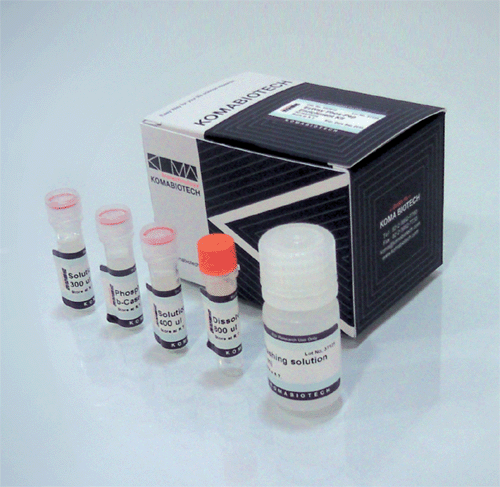
EzWay Phos-Pep Enrichment Kit
Features
Kit Contents
How to Use
Background
Protein phosphorylation is one of the most frequently
occurred posttranslational modification and plays a
critical role in cellular regulatory events. Most
cellular processes are in fact regulated by the
reversible phosphorylation of proteins on serine,
threonine, and tyrosine residues. Despite the importance
and widespread occurrence of this modification,
identification of protein phosphorylation site is still
a challenge, due to the low copy of phosphorylated
proteins in cell, even when performed on highly purified
protein.
Mass spectrometry has been shown to be a reliable and routine tool to identify proteins in a high throughput manner. However, the identification of phosphorylation sites by mass spectrometry is not a trivial matter and to this day is not routine. The detection of phosphopeptides by mass spectrometry in a complex mixture, such as a tryptic mass fingerprint, is a rare occurrence. This is thought to be caused by suppression of the ionization of the mainly negatively charged phosphopeptide in the presence of a large excess of nonphosphorylated peptides. EzWay™ Phos-Pep Enrichment Kit provides highly selective enrichment of phosphopeptide from non-phosphorylated complex trytic digest of proteins and facilitates the identification of phosphopeptide by mass spectrometry. Phosphopeptide identification relies on measuring the loss of mass. Phosphopeptides tend to lose their phosphate group as phosphoric (H3PO4) or phosphorous acid (HPO3) due to metastable decay in MALDITOF, ESI (PSD)2,3 ,ion trap(CID) or as phosphorous acid (HPO3) by phosphatase.
Phosphopeptide enrichment from trypsin digest of
phosphoprotein
Phosphopeptide enrichment from beta casein
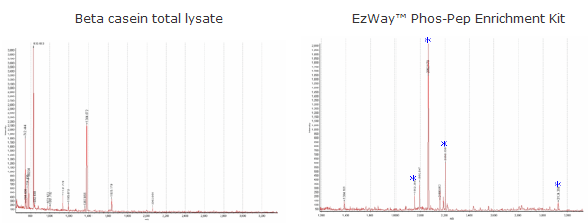
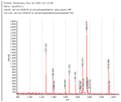
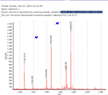
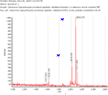
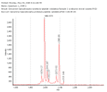
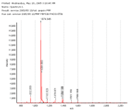
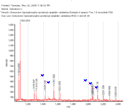
MALDI-TOF mass spectrum of beta casein trypsin
digest (left) and enriched phosphopeptide from beta
casein trypsin digest using EzWay Phos-Pep Kit
(right). Blue asterisk represent the enriched
phosphopeptides.
|
|
|